Why Chinese Family Names Usually Come First
Why Chinese family names usually come first, how to spot the surname, and how to handle names respectfully on forms, badges and introductions.
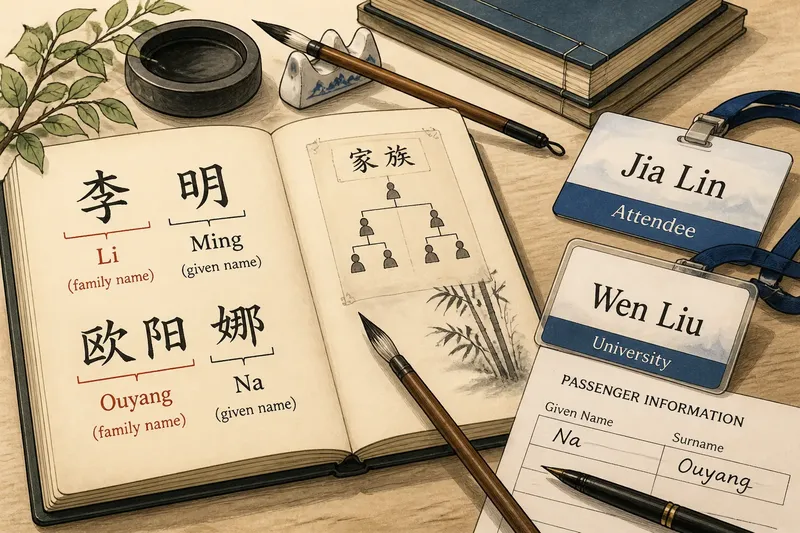
Why do Chinese names usually put the family name first? In a name such as Li Ming, Li is generally the surname and Ming the given name. This order is a common convention, but it is not followed by every person or institution in every setting.
The family name usually comes before the given name
In the usual Chinese name structure, the family name comes first. Wang Xiaoming is read as Wang, the family name, followed by Xiaoming, the given name. The sequence places family identity before the individual given name, without making that name any less important.
The same order is generally used when writing Chinese names in Chinese characters and in Hanyu Pinyin, the standard romanisation system for Mandarin. Think of it like a folder label: the first part gives an organising cue, while the next part identifies the individual more specifically. In conversation, though, a person's preferred form of address still depends on relationship, setting and personal choice.
Kinship and inherited surnames help explain the convention
Chinese family names are connected to kinship, descent and family lines. Surnames are inherited across generations, so placing one first makes a person's family name visible in the written name. Given names distinguish people who may share that surname.
This background should not be treated as a complete account of how every person understands identity. Name order is a convention, not a portrait of someone's values. Families may choose a given name for its sound, written characters or associations.
Many Chinese surnames have one syllable, such as Chen, Liu or Zhang. Others have two, including Ouyang. In Ouyang Na, for instance, Ouyang is the surname and Na the given name. Counting syllables alone can therefore lead to a mistaken guess about where the family name ends.
Character count does not always reveal the name boundary
A Chinese given name may consist of one character or two. A three-character full name is common, but length alone does not tell you which part is the surname: a two-character surname followed by a one-character given name can also make three characters.
Spacing in Pinyin can vary. The same name might appear as “Wang Xiaoming” or “Wang Xiao Ming”, depending on the person's preference or the style being used. Capital letters and spacing may offer clues, but in a formal or unfamiliar context, check the person's own spelling or ask which part is the family name.
Written Chinese gives each character its own visual space, but that does not remove every ambiguity for a reader unfamiliar with the name. Treat the usual order as a useful starting point, not as permission to guess at pronunciation or familiarity.
Romanised names may be rearranged for an audience
In international settings, some people change the order of a romanised Chinese name to suit local expectations. Someone whose Chinese name is Liu Wen may introduce themselves as Wen Liu in an English-language workplace, on a university record or in a publication. Others keep Liu Wen in every context, or use a chosen English name alongside their Chinese name.
There is no single presentation that applies to everyone. A person may retain family-name-first order on an official record while using given-name-first order in everyday professional communication. School, employer and booking-system fields labelled “first name” and “last name” can also encourage a different arrangement.
Say you receive a conference badge reading “Jia Lin” and do not know which part is the surname. If the attendee's profile lists Lin as the family name, you could use Ms Lin in a formal exchange if that form of address suits the situation. If the badge is your only clue, start with a neutral greeting and ask how the person prefers to be addressed.
Forms and introductions serve different purposes
A form collects information in a standard format; an introduction tells you how someone wishes to be known. An airline booking system may require separate given-name and surname fields, while a person may write their full Chinese name in family-name-first order elsewhere.
For official documents, follow the organisation's field labels and spelling instructions, and use the name shown on the relevant identity document. For an email signature, name badge or introduction, follow the person's own presentation. A system that capitalises the surname or places it last does not, by itself, mean the underlying convention has changed.
When you are unsure what to say aloud, listen to the introduction and notice how colleagues address the person. A title plus family name may suit a formal exchange where it is customary and welcomed. In a casual setting, use the name the person offers rather than assuming its romanised order must match your expectations.
Personal and family choices can differ from the usual order
“Family name first” describes a common convention, not an unbreakable rule. People with Chinese heritage may use names shaped by more than one language or family tradition. They may have a legal name, a Chinese name, an English name or a chosen name for different parts of life.
Some people adopt given-name-first order when communicating in English; others deliberately retain family-name-first order. A person may also use a two-character surname, a hyphenated form or a different romanisation of the same Chinese characters. Preserve these choices when addressing or recording someone's name rather than treating them as errors to fix.
Full-name order and form of address are separate questions. Knowing that Chen is someone's family name does not tell you whether to say Chen, use a professional title or use their given name. Relationship and preference decide that part. When the situation allows, ask, “How would you like me to address you?”
How should you handle an unclear Chinese name?
Is the first part of a Chinese name always the surname?
It is the surname in the usual family-name-first convention, but people and institutions may present names differently. Check the person's own spelling or ask if the distinction matters.
How can you tell where a two-character surname ends?
Some surnames, including Ouyang, use two characters, so syllable count can mislead. A reliable source provided by the person is more useful than guessing from name length.
Should you change the order on an English-language form?
Follow the form's fields and the organisation's instructions while preserving the person's official spelling. If the expected order is unclear, ask the administrator rather than silently rearranging the name.
How should you address someone whose surname you know?
Use a title and family name only when that suits the relationship and the person accepts it. Otherwise, follow their introduction or ask which form of address they prefer.
Knowing why Chinese family names usually come first helps you read a name without assuming every setting will display it the same way. Keep the person's chosen spelling intact, distinguish name order from preferred address, and let their own introduction settle the details.