Why Chinese Characters Can Share a Component Without Sharing a Meaning
Learn how shared components in Chinese characters can hint at meaning or sound, and how to tell when to check a dictionary instead of guessing.
Why can two Chinese characters share a component without sharing a meaning? Shared components in Chinese characters are clues, not translations: the full character, its pronunciation and the word around it all matter.
A familiar shape can help you notice how a character is built, but it does not always explain the character’s modern meaning. The component may suggest a broad semantic category, hint at pronunciation, or offer little help to a learner. Treat each possibility as a question to check, not a rule to apply.
Shared components in Chinese characters are clues, not definitions
Characters are often made from smaller elements. A dictionary’s radical is the element it uses to organise an entry; “component” is a broader term for a visible part of a character. A component can have a semantic or phonetic role, and some parts have no clear, useful role for a beginner.
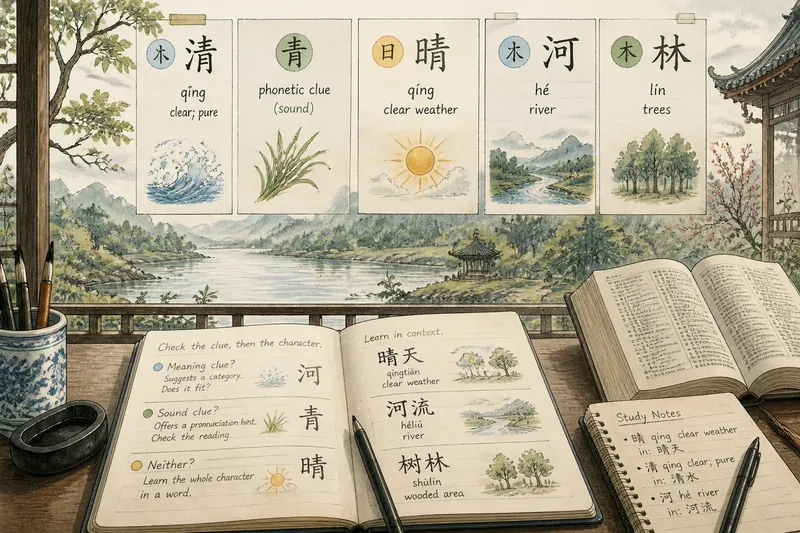
木 is associated with wood and trees. 林 and 森 contain repeated tree-related forms and refer to wooded growth. That makes 木 a helpful clue in these characters, but it does not mean every character containing 木 names a tree or wooden object.
A component is like a label on a drawer: it may point you towards a category, but it cannot tell you exactly what every item inside means. Check the whole character and how it is used in a word.
Use a semantic clue only when it fits
A semantic component can suggest a broad area of meaning. The water-related 氵, a shortened form associated with 水, appears in 河 (river) and 湖 (lake), where the association is easy to see.
In other characters, the connection may be indirect or hard to recognise today. If a proposed explanation feels strained, learn the character as a whole instead of inventing a story to make its parts fit.
Ask whether the component points towards a general category that makes sense for this character. If it does, keep the link as a tentative memory cue. If it does not, set it aside.
Check whether a component offers a sound clue
Many characters combine a semantic element with a phonetic one. The semantic element may suggest a broad meaning category, while the phonetic element may offer a pronunciation clue. The two characters can therefore share a component and have similar-sounding readings without sharing a meaning.
清 and 晴 both contain 青. In Mandarin, 清 is qīng, meaning “clear” or “pure”, while 晴 is qíng and refers to clear weather. The shared 青 offers a sound clue; 氵 in 清 and 日 in 晴 point towards different areas of meaning. Learn each full character and its tone rather than relying on the shared part.
A phonetic clue is not a precise reading guide. Pronunciation can vary between characters, and a component alone does not tell you the tone reliably. Check an unfamiliar reading in a Mandarin dictionary or a trusted audio source.
Learn the whole character when its parts do not help
Sometimes a recurring part is easy to spot but offers little help with meaning or sound. Learn the written form, pronunciation and meaning together, then meet the character in a familiar word or sentence. This is a sensible way to use structure without forcing an explanation.
For study notes, record the character, its pinyin and tone, a concise meaning, and a word that contains it. Add a component note only when it helps you remember or distinguish the character. A component’s dictionary role does not, by itself, explain the character’s modern meaning.
What should you check before using a familiar component?
Does a shared component mean two characters have related meanings?
Not necessarily. A semantic component may suggest a broad association, while the same visible part can appear in characters with different meanings or mainly provide a sound clue.
Can one component tell you how to pronounce a character?
It may offer a useful hint if it functions as a phonetic component. Check the complete character’s pronunciation and tone in a dictionary or audio source.
Is every recurring part a radical?
No. “Component” is a broad term for a part of a character; a radical is the part a dictionary uses to organise its entry. The part you notice first may not be the radical.
How should you remember a character when its parts do not help?
Learn its written form, pronunciation and meaning together, preferably in a word or sentence. A clear usage example is more helpful than a strained explanation of its pieces.
Sort a new character by the clue it actually offers
Say you already know 清 and meet 晴 in a weather sentence. You note that 青 may help with the sound and 日 provides a weather-related cue, then check a Mandarin dictionary and learn 晴 as qíng in 晴天, “clear weather”. The result is a memory link that distinguishes the characters, not a rule that every character containing 青 means weather or has the same pronunciation.
When a new character shares a component with one you know, decide whether the part offers a plausible meaning clue, a sound clue, or neither. Verify the reading when needed, and learn the character in context if its parts do not help. Shared components in Chinese characters can support recognition, but the whole character and its use remain the things to learn.