A First Visit: Small Ways to Follow the Host's Lead
A first visit to a Chinese home feels easier when you notice small cues, ask lightly and respond without assuming every household follows the same customs.
What should you do on a first visit to a Chinese home if you are unsure of the customs? Treat the visit as a conversation, not a test: notice what your host does, follow their lead where it feels comfortable, and ask a simple question when a cue is unclear.
Chinese households differ by region, generation, family and personal preference. A practice that feels natural in one home may not matter in another. The useful skill is not memorising a fixed list of rules; it is making room for your host to show you what suits them.
Let the invitation set the tone
Before you arrive, listen for practical details in the invitation. Your host may mention a meal, a relaxed visit, bringing something, or a time to come. If these details are missing and they affect your plans, ask briefly: “Would you like me to bring anything?” or “What time would suit you?”
A small gift can be a thoughtful gesture, but it need not be elaborate. Tea, fruit or a modest item connected to a shared interest may be appropriate; an expensive present can feel awkward. If your host says not to bring anything, you can take that answer at face value rather than trying to solve an imagined social puzzle.
There is no single household custom to infer from someone’s Chinese background. If you have a dietary restriction, mention it plainly before a meal rather than hoping your host will guess. This gives them useful information without asking them to speak for an entire culture.
Use the doorway as a moment to observe
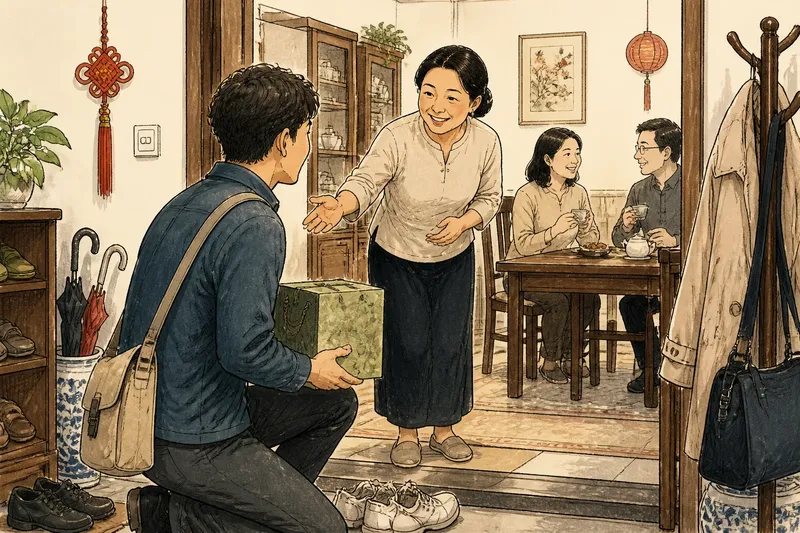
At the entrance, pause long enough to see what your host does. They may invite you to remove your shoes, point to a place for them, or wave you further inside. Follow that immediate cue. If it is not clear, ask, “Would you like me to take my shoes off?”
Keep your coat, bag and umbrella close until your host indicates where to put them. A hallway may be shared or crowded, and a bag left in the way can become a small nuisance. You do not need to inspect the home or comment on private rooms. Wait to be shown where to sit or to have a comfortable seat offered.
Think of following a host’s lead like matching the pace of someone walking beside you: you stay attentive without forcing them to explain every move. The aim is ease, not imitation. If your host behaves differently from what you expected, their own cue matters more than a rule you heard elsewhere.
Let the host guide the shared space
During the visit, notice how your host handles food, drinks and conversation. They might offer tea at once, ask what you would like, or leave a drink within reach. Accepting, declining or asking for a little time can all be done warmly. If you do not want more, a clear “No, thank you, I’m fine” is kinder than accepting and leaving it untouched.
At a meal, wait for the host to indicate that everyone can begin, or follow the others if they start together. Use serving utensils when they are provided. If you are unsure whether a shared dish is for everyone, ask before reaching across the table. Your host may serve guests, invite them to help themselves, or do both; watch the pattern rather than assuming one style.
Conversation has its own cues. A host may ask personal questions out of friendly interest, while another may prefer lighter topics. You can answer briefly and then ask a question of your own. If a subject feels private, shift gently: “I’m still thinking that through. How did you choose this tea?” A warm change of subject can set a boundary without turning the visit into a confrontation.
Ask when a cue is genuinely unclear
A short question usually takes less effort than worrying silently. Keep it specific and easy to answer; “Where would you like me to sit?” is more useful than asking your host to explain every household rule. Ask once, listen to the answer, and move on.
Say you arrive with a small box of tea, and your host says, “You didn’t need to bring anything.” You can smile and reply, “I thought you might enjoy it,” then set it aside where they indicate. If they open it later, you need not treat that as a signal about future gifts. The observable point is simply that the host has acknowledged it and chosen what to do next.
If you make a small misstep, a brief apology is usually enough. You might have sat in a place your host meant to use, or started eating before everyone was ready. Say, “Sorry, I didn’t realise,” and adjust. A long explanation can make a minor moment feel larger than it is.
What should you do if you are unsure?
Should you take your shoes off?
Look for the host’s gesture, the arrangement at the entrance or a place for shoes. If none of these makes the expectation clear, ask directly and follow the answer.
Should you bring a gift?
If the invitation does not mention one, a modest offering is optional rather than a requirement. Ask whether your host would like anything, and respect a clear response.
What if you cannot eat a dish?
Explain a dietary restriction before the meal if possible, and decline a particular dish politely if needed. You can thank the host for offering without giving a lengthy account of your reasons.
How can you tell when it is time to leave?
Notice whether your host is gathering belongings, mentioning another commitment or bringing the visit towards a close. If you are uncertain, ask whether it is a good time to head off; the question lets your host answer without pressure.
Leave the visit on a clear, warm note
When you are ready to go, thank your host for the time and, if relevant, the meal. You do not need an elaborate speech. If they offer something to take with you, accept or decline graciously according to your comfort; the offer itself does not create an obligation.
A short message afterwards can mention one specific thing you enjoyed, such as the conversation or a dish. Keep it genuine and uncomplicated. For a first visit to a Chinese home, that combination—attention, a light question when needed and a sincere thank-you—helps you respond to the household in front of you rather than to an imagined set of universal rules.